


I think we can all agree that Jeffrey Epstein was an absolute piece of human garbage. And frankly, if there is a hell, I hope he’s rotting in it. Compared to everything else he did, this gripe is minor — but it still says something deeply disturbing about how he and the people around him viewed the world.

Recently uncovered emails show that **Jeffrey Epstein’s advisors were in discussions with former Activision CEO Bobby Kotick about microtransactions in Call of Duty as far back as 2013.
Researchers identified an email thread involving Epstein, futurist Pablo Holman, and Kotick. In it, they discuss the idea of “indoctrinating” children into economic systems through games.
Let that sink in.
Even setting aside the far more horrific crimes committed behind closed doors, this language is revealing. It shows a mindset that viewed children not as people, but as a resource — something to be conditioned, monetised, and exploited. That outlook didn’t stop at abuse; it extended into business.
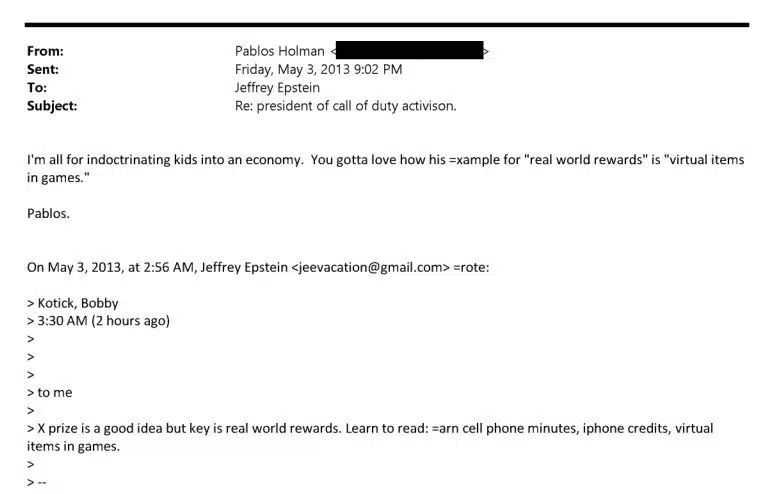
The email exchange dates to May 3, 2013, just months before the release of Call of Duty: Black Ops II. Notably, Black Ops II became the first Call of Duty title to introduce microtransactions, with paid cosmetic items like calling cards and extra loadout slots appearing in April 2013. While this doesn’t prove causation, the timing strongly suggests these discussions were part of a broader push toward monetisation.
Fast forward thirteen years, and microtransactions are now baked into almost every major game release.
Compared to Epstein’s other crimes, this is small — but it’s still telling. It highlights how casually powerful people talked about shaping and profiting from children, and how those attitudes helped normalise systems that now dominate modern gaming.
And that, too, is worth being angry about.


